Showing posts with label Multible Myelome. Show all posts

Myeloma patients could soon benefit from targeted therapy |  City of Hope Breakthroughs

Myeloma patients could soon benefit from targeted therapy |  City of Hope Breakthroughs

Many cancer patients have benefited from targeted therapy – medications that can identify cancers by their genetic properties and help eradicate them – but such therapy has been largely a pipe dream for multiple myeloma patients. Until now.
Myeloma
New drugs could provide targeted therapies to patients with multiple myeloma.
Currently, two medications are emerging as especially promising in the treatment of multiple myeloma: daratumumab and SAR650984. Each of the drugs  target different  sites on the same receptor for multiple myeloma.  Each was the subject of research presented at the annual meeting of the American Society of Hematology.
The drugs are offering new hope to patients who have already tried many other therapies with less-than-ideal results.  “The most important thing is that these are targeting the patients who have high-risk disease who have been refractory to the other agents we’ve had standardly available,” said  Amrita Y. Krishnan, M.D. FACP, director of the Multiple Myeloma Program at City of Hope. “To see responses in these very advanced patients is extremely compelling.”
Data supporting the drugs’ effectiveness has been building, and Krishnan expects it to continue to develop in the coming year.
Because the drugs have different targets, if a patient does not respond to one of them, the other may prove beneficial.
“This is going to be a very interesting question as time goes on,” she said. “Right now, I don’t think we have enough to be able to pick out a patient who is going to respond to one compound versus the other.”
Myeloma is a cancer of the plasma cells, which normally produce anitibodies to help fight infections. Ultimately, it can interfere with production of normal blood cells and cause serious complications in bones and kidneys. When these cancerous cells form tumors throughout the body, it is classified as multiple myeloma. One of the treatments for the diseases, beyond chemotherapy and radiation, is stem cell transplantation.
**

Interesting cancer stuff

http://www.myelomacrowd.org/patient-power-smoldering-orlowski/

Key Answers for Smoldering Myeloma Patients

Patient Power has created a very helpful series of videos to answer important questions posed by myeloma patients. Here are key questions that are critical to smoldering myeloma patients, answered by Dr. Robert Orlowski, MD, PhD of the MD Anderson Cancer Center.
Watching and Waiting for Smoldering Myeloma: What Tests and When?
Can Anything Stop MGUS and Smoldering Myeloma from Progressing to Symptomatic Disease?

What Clinical Trials are Available for Smoldering Myeloma Patients?

Interesting new take on Multiple Myeloma

http://www.mpatient.org/dr-saad-usmani-2/

Summary
Dr. Saad Usmani is the new director of the Plasma Cell Disorder program and the director of Clinical Research in Hematology myeloma program at the Levine Cancer Institute. He shares three key lessons he learned through his work at UAMS: all myeloma is different and the effectivity of the most used drugs will vary from one patient to the next; about 10-15% of myeloma patients are high-risk and resistant to most of these therapies; there is a big disparity in clinical trial access especially for racial minorities. He defines “high-risk” by clarifying that high-risk smoldering myeloma is the risk to progression to active myeloma, while the risk for a newly diagnosed myeloma patient is the risk to relapse after treatment has been given. He defines the highest risk features as being deletion 17p, translocation (14;16), translocation (14;20), and amplification of chromosome 1q21. Although the 4;14 translocation has been known to be a high risk feature, he notes that if bortezomib is used in therapy, these patients can have similar outcomes to normal risk patients, so 4;14 can be an intermediate risk factor. He gave a very clear explanation of the GEP test and other tests needed to determine risk and relapse. He shared his experience at UAMS showing that many high-risk patients getting transplant and even double transplant relapse quickly, so he prefers to use clinical trials and newer drugs instead of a melphalan-based treatment because of toxicity issues. He shares the first ever clinical trial specifically designed for newly diagnosed high-risk myeloma patients with del17, 4;14 and 14;20 that has two arms – the first uses Revlimid-Velcade-dexamethasone and the second uses Revlimid-Velcade-dexamethasone with a newer monoclonal antibody that targets the CS1 protein called elotuzumab. He describes how and why the trial was constructed. This SWOG 1211 trial is available in the US and in Canada and is the first major trial to address the needs of high-risk patients. He now provides deep myeloma expertise in the Charlotte and surrounding area for an underserved patient population.

Interesting...

http://multiplemyelomablog.com/2014/03/does-a-cure-for-multiple-myeloma-already-exist.html

Does a cure for multiple myeloma already exist?

Posted on March 05 2014 by Pat Killingsworth | 389 views
  

We spend so much time hoping and praying for a cure.  Could it be that for some, a cure already exists?
Most of you should already be familiar with Total Therapy (TT).  Developed over decades by Dr. Bart Barlogie at the University of Arkansas School of Medical Sciences (UAMS), TT is often criticized for being unnecessarily toxic and intense.  Yet as time goes by, TT has been producing some impressive numbers; half of low risk patients treated this way are living at least ten years.
But the question remains: do these impressive survival numbers prove some of these patients are cured?  Well read blogger and myeloma survivor, Nick Van Dyk, is part of the TT success story.  He was kind enough to jot down some of his thoughts about it:
nick van dykeI believe that Total Therapy represents a potentially curative option for a meaningful subset of newly diagnosed patients and can exceed a 50% cure rate for patients in the right population.  Patients who have (1) not undergone meaningful amounts of previous treatment for the disease, who are (2) young enough to benefit from the additional lifespan beyond the potential 5-10 years that less invasive therapy generally provides in a successful case, who are (3) healthy enough to receive multiple courses of chemotherapy including two high-dose courses of Melphalan, who are (4) psychologically prepared to embrace an aggressive treatment protocol and who are (5) prepared for the logistics of an extended stay at a center of excellence for this treatment (whether Little Rock, Iowa, etc.) should consider that, if they are in the 85% of patients with “low risk” disease, they have a better than 50% chance of being cured.
Does this statement with all its qualifications mean that Total Therapy constitutes a cure for the disease?  Biologically, it probably constitutes a good shot at it for those that are otherwise healthy.  Psychologically, not all patients are prepared for it — and I think that’s in part because they have been led to be terrified by the concept of a transplant, which is a shame.  For the older diagnosed patient (Tom Brokaw comes to mind), the incremental few years of life in his late 80s may not be worth the added intensity of treatment versus the less invasive program he is receiving at Mayo.  For the high risk patient, unfortunately, few if any cases are cured through existing treatments.  But still — for someone like me, diagnosed at 40, otherwise healthy, and prepared to fight like hell — the chance of a cure is not some shot in the dark, 2% chance.  It’s even money or better — and once one achieves remission and maintains it for a period of time, it approaches certainty.  Whether that period of time is 6 years, as BB (Dr. Bart Barlogie) and team now maintain, or some longer time frame as Rajkumar appears to suggest, it’s out there.  Dr. Rajkumar agrees with that much, and notes that people were cured 20 years ago with Melphalan and Predisone — just not very many.
BB and Total Therapy are curing a meaningful portion of patients that undergo Total Therapy.  Patient empowerment and a gradual broadening of the centers that offer Total Therapy as a choice should increase the reach of this alternative, and that’s a good thing.
My thoughts?  It’s clear to me that many myeloma specialists are beginning to advocate hitting multiple myeloma upfront and hard.  That’s what TT does.  There does seem to be some disagreement over whether tandem transplants are necessary.  However, employing them is consistent with a mission focused on knocking out myeloma early, before it can morph and evolve into multiclonal, drug resistant disease.
Are some patients that undergo Total Therapy cured?  Possibly.  But how many?  Certainly not 50%.  10%?  20%?  Your guess is as good as mine.  But keep in mind that otherwise healthy, low risk patients are likely to live longer regardless of the therapy.  Mayo Clinic just completed a retrospective study, looking back at low risk patients that had been treated there using incremental therapy.  The median life expectancy was also ten years.  I don’t believe the study tried to identify a cure rate; Mayo Clinic specialists still consider multiple myeloma incurable for all but a few “outliers.”
I believe this ongoing debate is a healthy one.  While we may not agree about how many patients TT cures, Nick and I do agree that the option of being treated aggressively should be offered to younger, low risk patients regardless of where they’re treated.
Thanks, Nick!  Here’s the link to his blog:
Feel good and keep smiling!  Pat

All OK!


Well, those lesions that showed up on the full body x-ray ended up being... something else.

What?  I dunno - and neither does Dr. Lee.

But what is known is that the bone density scan, full body x-ray, blood tests, and bone marrow biopsy all concluded that there is no cancer present, presently.

I have to admit, I was more than a bit worried that it was back.

Still, the odds are that something will pop up, at some point.


Here is to later, as opposed to sooner...

I need a nap.

jc

Doctor update

Well, the unending stream of good news has stopped.  Perhaps just a pause...


The bone survey showed three lesions  - right arm, left arm, and the top of my skull.

Kidney function was still "ok" but pretty close to the upper edge of normal.

So - still waiting on the IGD blood test to come through, and I have a bone marrow biopsy in July.

Scheduled a bone density test for later this month also.

The cancer shows up in the bones first - so yes - I am sweating it.

Now I have to go to COSTCO and prepare for an audit/EPA action/OSHA inspection/NSA anal probe...

jc

Cool! Thanks for the views

Considering I never advertise, it is nice that I get hits.

This is basically a place for me to rant and leave my thoughts for the moment.  It is also a time capsule of progress on my cancer  - the first motivator on starting this blog.


I just thought that this was cool...

Thanks!

jc

Five Years

Five years ago today I was diagnosed with Multiple Myeloma.

I was in a hospital bed, surrounded by family, when Dr. Lee came in and explained what was the problem.  Good thing the family was there - I was so hopped up on morphine that if he had told me that I had a bad cold I would have believed him.

I was checked into the hospital about a week earlier by Dr. So, a neurosurgeon who I had an appointment with to see if he had any ideas as to why my back hurt so bad, and that I could barely walk.  He made me sit in the waiting room for at least two hours, only to put me into a examination room for another 45.  I was livid.  As he explained to me, I wasn't going home - I was checking directly into the hospital, just a short wheelchair ride away.

Tests, morphine, back braces, morphine, physical therapy, morphine, Magnetic Resonance Imaging, morphine, full body x-rays, morphine, CAT scan, and more morphine.  I did everything but poop - because of the morphine.  That glorious event took eleven days, and it was literally like passing a softball.

Looking back, my cancer was so out of the norms that it makes sense that it took so long for them to figure it out.  They started radiation immediately to shrink the tumors on my spine, and the first round worked great.

When I went back to Dr. Lee a week later I told him that over the last 3 days I had lost feeling in 3 of my fingers.  Bad Jim!  MRI again and another round of radiation to kill off the new tumors growing on my spine.

Revlomid, Thalidomide, countless other pills, I eventually stabilized   I walked again, though with peripheral neuropathy I am in constant fear of injury without pain.

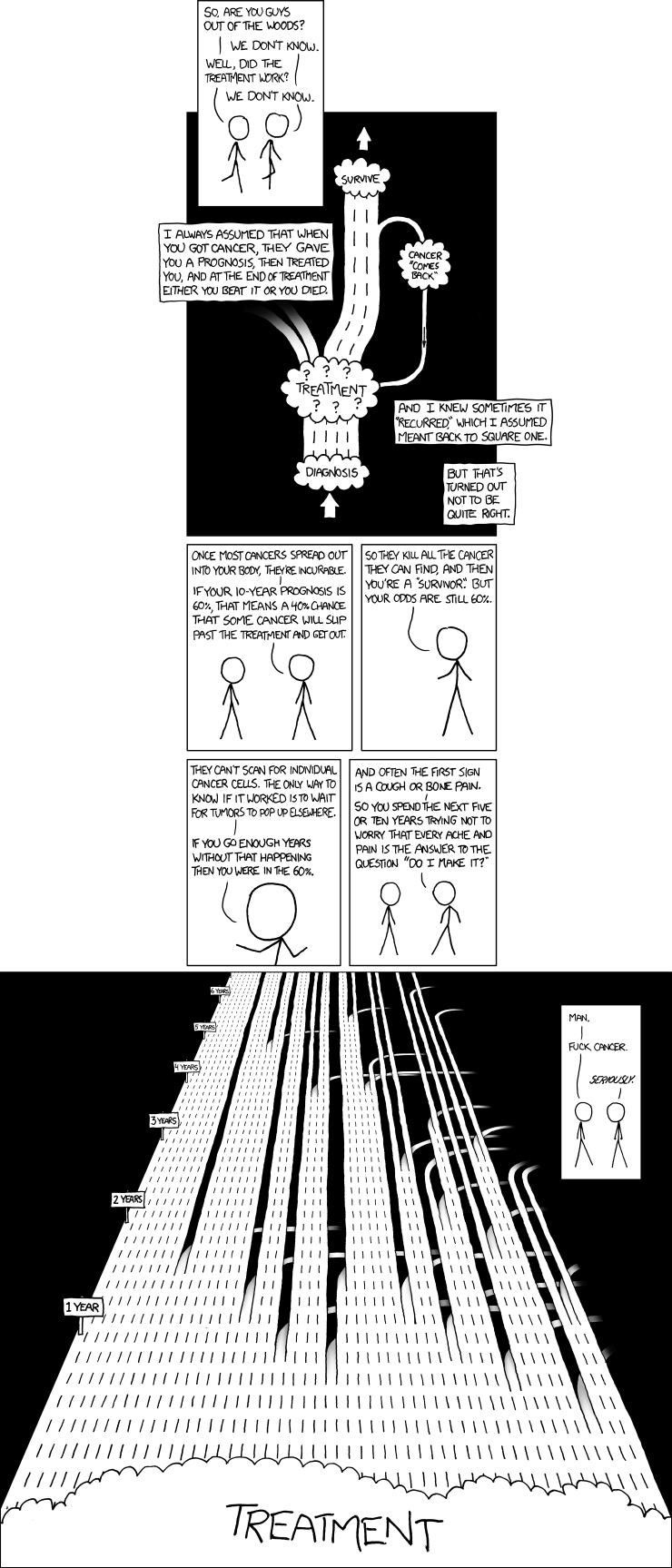
The odds are still greatly against me - 70% chance of a return at any time.

There is no 5 year "Cancer Totally Cured" card for MM.  

I look at things differently now - I tend to be a bit more bold and for the most part I don't really give a flying f--- if I piss you off.  If I cut you off for wasting my time, understand that my time horizon is both shorter (or intense) than yours and philosophically more long term (yes, a conundrum).

I keep this blog up to remind myself just how far I have come - and how much further I have to go.


Now I gotta go watch Duck Dynasty...

jc

Health update

Well, I saw Dr. Lee yesterday, and all seems to be going well.

The bone marrow biopsy came back as generally OK. He noted some elevated numbers in my IGD, but nothing else -- which seems like an anomaly and not much for concern. Yet.

He gave me the surgical pathology report, and while I am not a doctor (or even play on on TV) I can read this:
NO EVIDENCE OF MONOCLONALITY IN B-CELL POPULATION
I take that as something good.

My visits to the chemo lab for AREDIA are to be cut in half, and I don't see Dr. Lee until next January.

Generally good, eh?

My back still has its days, and my bone marrow is only at 50% or so. If I get sick (something I don't do very often) it will take me much longer to get better. I really notice that I notice faces, but absolutely blank out with names (very awkward, socially). I am quite stiff when it comes to movement, except when standing still: my back does an involuntary wiggle that seems like it is under/over correcting itself. My stamina is OK for a while, but it takes me much longer to recover. I seem to be just barely stable -- my balance is just not as balanced as before. If I do get off balance, I don't have the quick (or even automatic) muscle response to correct it in time. Not good when dodging beagle pups.

All told, I think I am doing quite well. Considering that in March of 2008 I could only walk with a walker, and could not get out of a bed without horrific pains in the back, I think that I am doing VERY well. Just wish these 100 little things would hurry up and stop making me feel older than I am.

Gotta go clean up puppy stuff --
jc

Cancer update

Have not even put in the blog what the cancer is. Multiple myeloma , the third (rarest) form. Can't remember the technical word for it, I have an appointment tomorrow, and will get the official term (so you can be informed if you want).

Anyway, I will post the history of how I got here later. Here is what is happening now.

I have been deemed a prime candidate for Autologous stem cell transplantation at the City of Hope up in Duarte. It seems simple. They suck out MY stem cells, store them on a shelf somewhere (hopefully not by the diet Coke), zap the cancer cells with a chemo a-bomb, sweep up my hair, give me back the stem cells to regrow my bone marrow, and I am all (mostly) better.

But, alas, it seems that there are "procedures" and strange oath to "do no harm", so I have to get tested, poked, prodded, plumbed, folded, spindled and mutilated (chrome dome). Sigh, my dream of being the first male supermodel is crushed.

The testing starts tomorrow. After I meet my Hematology Oncologist, I get an x-ray of my whole body, my chest (I guess its a different x-ray beam they use), EKG, 24 hours of urine (two buckets, please!), and everyone's favorite -- a bone marrow biopsy.

I had a bone marrow biopsy when I was in the hospital. They give you a local anesthesia in your butt cheek. Then comes the big needle. It looks like a spare coffee stir stick from the cafeteria. It has to be big and strong because when they jam it in you they have to break through your hip bone. Can't deflect right, can't deflect left, straight in -- and through. Local anesthesia doesn't go very deep. Breaking a bone hurts. Sort of. Remember the Starbucks straw sticking out of your butt? They start sucking on it like its some sort of
Frappuccino Blended Coffee. That hurts. There is nothing local they can anesthetize in the hip bone. It is indescribable, unless you have had it done. It's like the Parris Island of cancer patients ("Had one?" "Yea, two actually." "Wow, more power to you...").

Wednesday or Thursday I get to do blood work. 30 vials of blood work. My previous record was 12. I'll ask if I can have a beer afterward for some real fun!

The schedule gets a bit hazy after that, waiting on those protocols to kick in, but I get my own semi-permanent exterior plumbing for injections and extractions, chemo, needles I have to inject into me and not the plumbing, hours (over days) of being hooked up to a harvesting machine, the a-bomb of chemo, then into the hospital for a few weeks to rebuild my bone marrow.

Won't be able to go to Disneyland for at least 100 days. DAMN!

Well, I started at 9:00, its 10:45, my steroids are still kicking in, and the sleeping pills are doing squat. I'll go to bed anyway.

jc